

The Big Picture
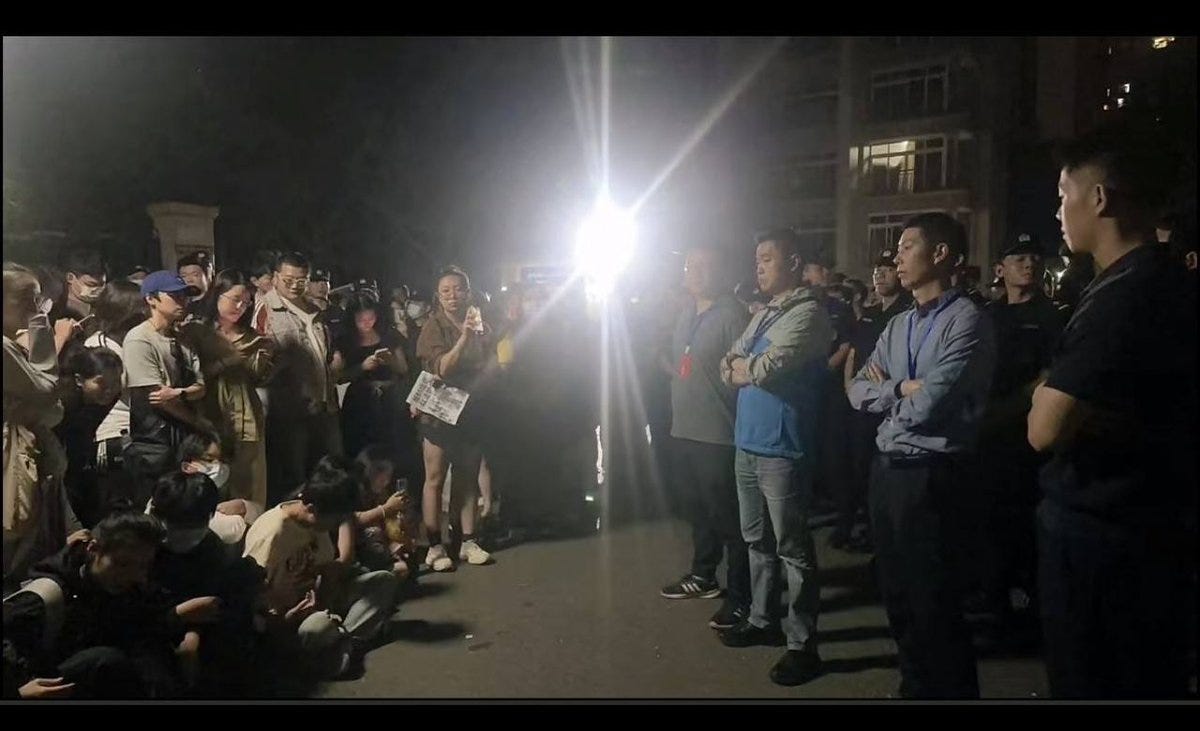
What brought riot police into a Chongqing housing compound was not a labor strike or a land dispute or a banned anniversary — it was dogs. Hundreds of ordinary people gathered to demand accountability for a man who tortured animals. The Chinese state met these protesters with the same force it reserves for any crowd it did not convene, because the lesson Beijing has drawn from history is that what matters is not the reason for a protest but the protest itself: the assertion of our freedom to gather. State fear was a theme this week as Koreans guarded ballot boxes through the night, a light was shone on the Chinese consulate in New York to mark the Tiananmen anniversary, and the absurd machinery kept grinding away in its neurotic fashion at the memory of June 4th.
I. What Draws the Riot Police
On June 4, an animal-rescue volunteer surnamed Wang gave a white puppy to a 39-year-old man surnamed Li. Li asked to see the mother dog’s size first then took the puppy, and by that afternoon — when Wang returned to the shelter — the mother dog had been beaten to death. Security footage showed Li had doubled back. Wang posted the footage online, and viewers recognized Li instantly: he was the locally famous “Sam’s Club Packing Guy” (山姆大包哥), who had gone viral in late 2024 for repeatedly looting the free-sample counters at a Chongqing Sam’s Club, hauling away food in his own containers and flinging soup at staff.
Once he was named, other victims came forward. Li and his wife, by the accounts that surfaced, had spent months posing on pet-adoption groups and on Xiaohongshu as a stable, loving family — wife at home, kids who adore dogs — sometimes with Li impersonating a woman. They did this to collect kittens and puppies. The cruelty described is forensic and total: teeth filed flat, tails cut off, bodies broken in multiple places, animals killed on a balcony and thrown from the height. Larger or purebred dogs were allegedly sold onward; small ones were tortured, sometimes on video — the footage perhaps for sale abroad or on the dark web. A neighbor had first called police on March 29. Nothing happened, because in China animal cruelty is not a crime — the country is one of roughly two dozen jurisdictions with no national anti-cruelty law at all.
What happened next is the story. Starting June 7, animal-rescue volunteers and residents — first dozens, then hundreds — gathered outside Li’s building in the Zhonghai North Riverside compound. They held signs: “Police: adoption fraud,” “Resist animal abuse — today indifference to a tortured animal, tomorrow killing a person without blinking.” They demanded an anti-cruelty law. People drove in from other cities; some brought their own pets; volunteers ran shifts through the night, hauling in supplies and portable power stations.
On the morning of June 9, the police moved on the crowd. Per our broadcast’s account and the footage circulating with it: officers dragged off protesters’ cars; a resident livestreaming the scene had his phone seized and shouted “the police are beating people”; a plainclothes officer pulled off his own uniform shirt before forcing a woman to her knees. A delivery rider, sent by an out-of-town supporter who had ordered food to the protest as a gesture, was detained on arrival. A foreign animal-welfare volunteer who showed up was detained too — “we’ve lost face all the way abroad,” the crowd called out. Officers ringed a man and pinned his head; several raised black umbrellas to block the cameras; one livestream showed twelve peaceful protesters taken away in three minutes, with the police audibly laughing as they worked. The volunteers responded by singing the national anthem at the police line.
The detail that fixed the week’s tone: while the volunteers were being cleared by force, the dog-torturer himself was, by multiple accounts, kept comfortable inside the local police station — “sleeping in the air conditioning.” On June 10 the Chongqing police announced that Li, having “obtained dogs by falsely claiming to adopt them” and then injured them, had been given administrative detention — a maximum of 15 days. By June 9 “Sam’s Club Packing Guy” and related terms were unsearchable on Douyin. Xiaohongshu accounts that posted in support were banned, device and all. A source inside the system said the propaganda department had ordered the three big platforms to suppress the footage of police beating volunteers.
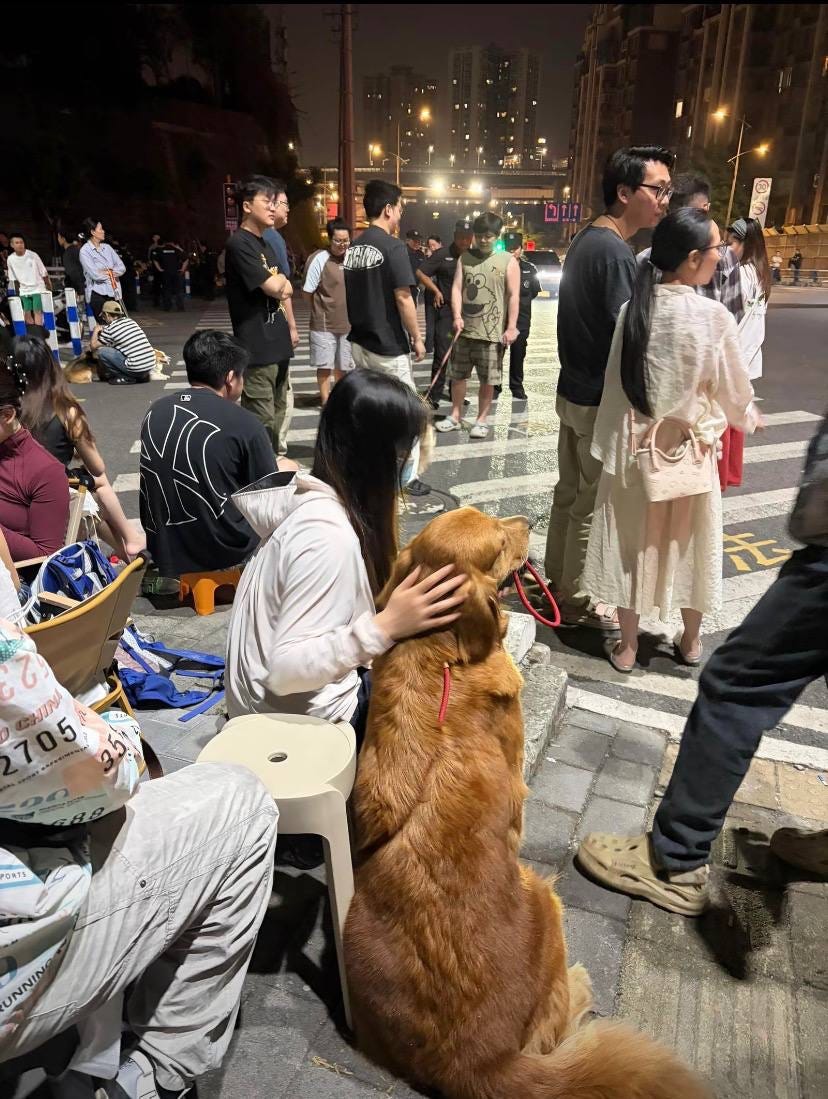
Why was the state so upset? Nikkei Asia headlined: “Rare protest over animal abuse spotlights China’s ‘mass-movement’ fears.” The protesters were not, by any reading, a political threat. But that is the point — the regime was policing the form, not the content. A spontaneous crowd of hundreds that the Party did not summon and cannot fully see is the thing itself, regardless of whether it has come on behalf of democracy or a dead dog. Major media carried the story but not the chant that became the week’s defining line, recorded in the small hours of June 10 outside the compound (3,638 likes):
“You beat a hundred people today; tonight it’ll be five hundred. You dare beat five hundred tonight, and tomorrow there will be five thousand.”
II. Seoul, Two Ways
On June 3, South Korea held nationwide local elections, the first since President Lee Jae-myung took office. Turnout ran high, near 61 percent. And ballots physically ran out: at roughly 50 of the country’s ~14,300 polling stations, paper ballots were exhausted, and voting was suspended at 22 stations when replacements failed to arrive in time, most visibly in Seoul’s Songpa District, where some voters queued for hours and left without voting. The National Election Commission said it had under-printed after underestimating turnout. Few were satisfied. By June 5, NEC chairman Roh Tae-ak had resigned; more than 6,000 people massed at Seoul’s Olympic Park demanding a rerun; protesters blockaded vote-counting centers through the night. Students at Ewha, Korea, Seoul National and other universities issued statements. (UPI, UCA News, the Korea Herald, The Diplomat, all covering it closely.)
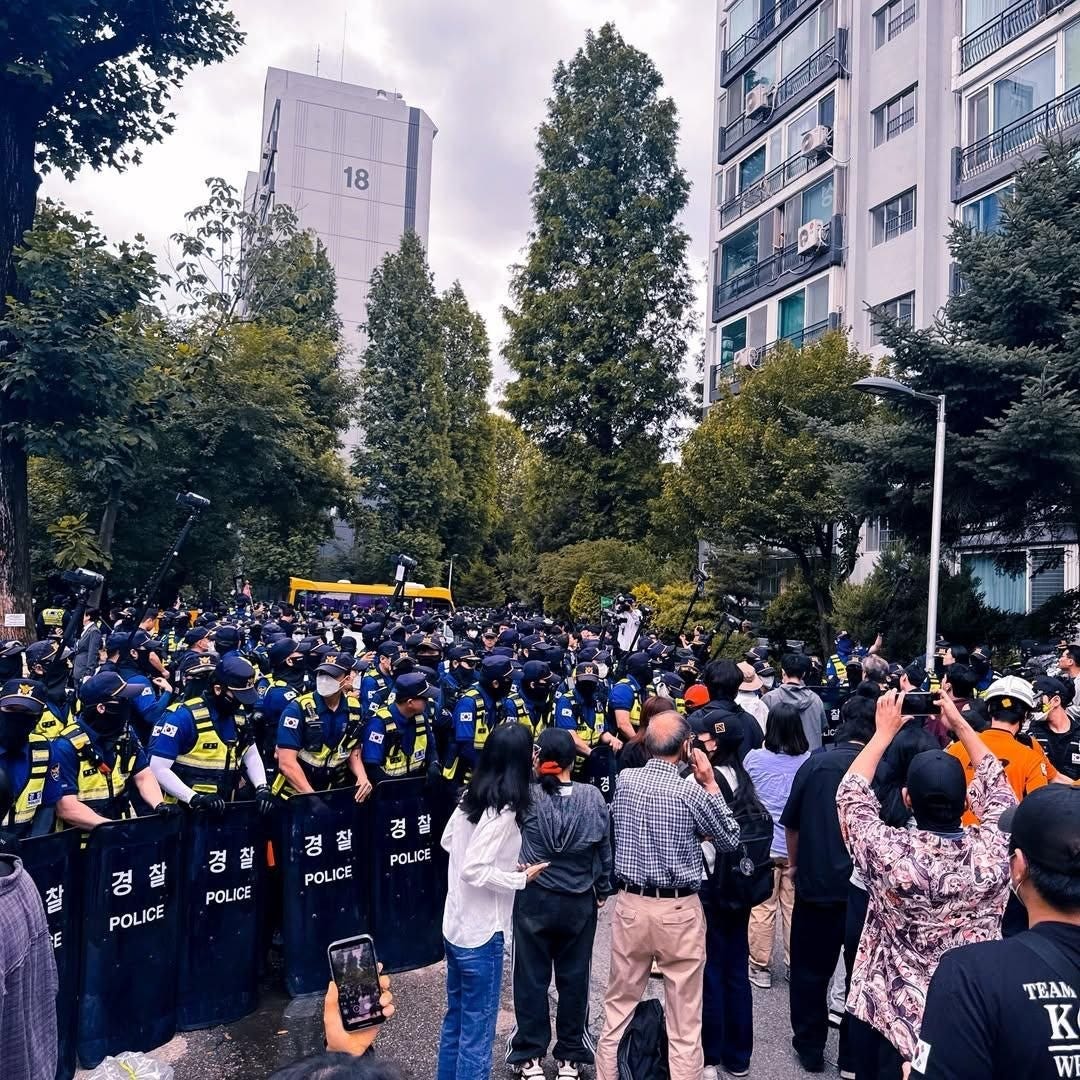
Here the two readings split. In the English-language mainstream, the fraud narrative is treated as a conspiracy theory — pushed hardest by former president Yoon Suk Yeol and a circuit of right-wing YouTubers, with Yoon claiming the NEC had ignored “North Korean threats to voter data.”
In the Chinese diaspora feed, the same images — torn ballots found in a bin, a monitor’s video of a sealed ballot box reopened and refilled — are read more as evidence, with an added note our broadcast flagged: Lee Jae-myung’s past use of Mandarin campaign appeals, and open speculation about Chinese or foreign-resident influence. A Korean administrative failure became, on the Chinese internet, a parable about whether any election can be trusted — which is a comforting story to be handed if you have never been allowed to vote in one.
What is not in dispute is the image the week supplied: in a free democracy, citizens stood in front of ballot boxes all night to make sure they were counted. The contrast our feed drew was not with Seoul. It was with home.
III. June 4, the Anniversary That Keeps on Giving
The Tiananmen-massacre anniversary passed on the 4th, but the apparatus kept grinding through our June 6 broadcast. Accounts were throttled or banned for posting that they had run 6.4 kilometers (6-4, or June 4), or for the line “2026 is half over.” Three streamers were banned simultaneously for a piece of background music judged “too loud” — each, the notice said, having violated one of the season’s three rules: can’t say numbers, can’t say repeated syllables, can’t be too loud. When games disabled their voice-to-text functions, a user asked Douyin’s AI assistant why Honor of Kings had switched it off, and the bot explained, in earnest, that it was to stop gaokao candidates from smuggling phones into the exam to relay questions — a sentence that is funny until you notice the domestic machine has been taught to launder censorship into an anti-cheating measure.
Against that, people improvised memorials with deliberate gentleness: buying KFC “Crazy Thursday” meals (see last week’s newsletter); building the Tank Man scene inside Final Fantasy XIV and Red Alert.
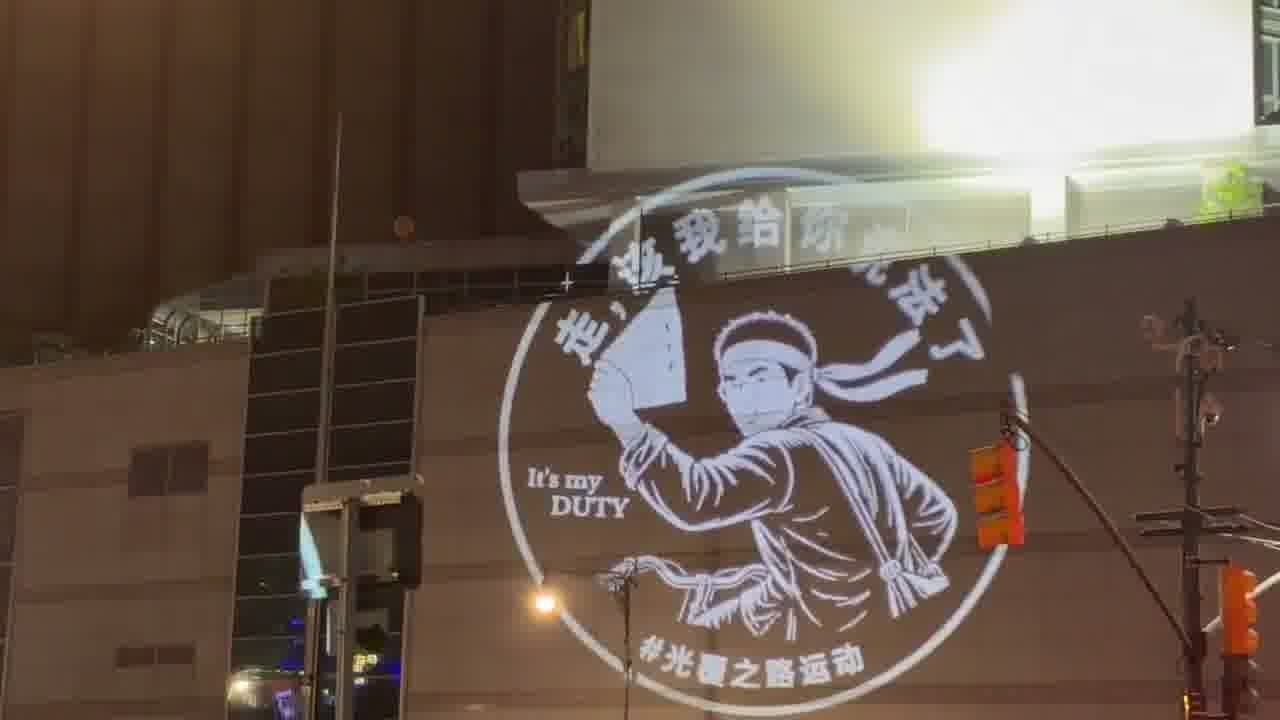
The most striking act was thrown on a wall. On the night of June 4 in New York, the “Path of Light” (光复之路) projection illuminated the facade of the Chinese consulate with images and three slogans — the bicycle-riding youth glancing back, three lines surfacing in turn (”walk, we are the people”; “walk, I have taken off the long gown”; “walk, it’s my turn to speak”). Consulate-hired security rushed the crowd and tried to reach the projector; the team called the police; the NYPD officer who responded told them he would refer the consulate’s interference to the FBI, and, leaving, said: “I respect what you’re doing.” The team’s own note: what is worth recording, they said, is not the images on the wall but the phenomenon — that a vast institution chooses to spend long-term manpower and hardware to fight a few quiet black-and-white pictures.
For readers who want the long view, China Books Review ran Frank Dikötter on the rise of the Party this week — the historical spine under all of it.
IV. Pyongyang
Last week we reported that North-Korea-focused creators were vanishing from the Chinese internet — Li Tangyou, following the earlier ban of Li Xuehua — and we guessed the purge might be clearing the ground for a thaw with Pyongyang. This week the thaw arrived. On June 8–9, Xi Jinping and Peng Liyuan made a state visit to North Korea, received by Kim Jong Un and Ri Sol-ju. It was Xi’s first overseas trip of 2026 and his first to the DPRK since 2019, timed to the 65th anniversary of the two countries’ friendship treaty (CNN, Al Jazeera, NPR; Sinocism carried it across the week, including a Sharp China episode). Xi called for deepening “strategic coordination and cooperation.”
Banning the Lis before Xi traveled tells you something the summit coverage does not: the scrubbing of content that invited Chinese viewers to compare their system to North Korea’s came before the embrace of North Korea’s leader. The comparison had to disappear from the feed so the handshake could appear on the news unsullied. Our audience noticed anyway; under the week’s surveillance and censorship items, the recurring phrase was the one the earlier purge was meant to prevent — “West Korea.”
V. The End of Easy Capital
Sinification‘s economic digest this week is titled, flatly, “The End of Easy Capital,” and our broadcasts filled in what that ending looks like from the ground.
The numbers first. Private investment fell 5.2 percent in the first four months of 2026, even as state-controlled investment rose 2.5 percent — the financial commentator Li Xunlei’s “respect the cycle” essay, which our June 6 broadcast carried, put the macro leverage ratio at 295.6 percent for 2025 and argued that growth is now propped up almost entirely by state banks, state firms and government borrowing. Local governments’ property-related revenue has fallen roughly 48 percent since 2021 (about ¥10.68 trillion down to ¥5.52 trillion), draining the budgets that pay for everything else — which is the through-line to the Henan county court our broadcast found charging creditors a 10 percent “enforcement fee”to actually collect on judgments, and promoting the deputy chief who brought the money in.
Then the floor. A new official report put China’s “flexible employment” at over 300 million people — roughly 40 percent of the workforce, in the English accounting (Epoch Times, NTU). On gaokao morning, the Communist Youth League’s own “Youth Voice” account published a poster that said the quiet part out loud: “Don’t stress. Fail the exam, and in four days you deliver food. Pass it, and in four years you deliver food” (3,618 likes). A Beijing delivery rider posted that his income no longer covers rent, so he has pitched a tent in the wild to live. Eggs, meanwhile, have climbed for five straight weeks to a multi-year high. Our broadcast cited the agriculture ministry’s near-80-percent year-on-year figure; the English trade press puts it nearer 40 percent (The Standard). Either way, a staple is doing something staples are not supposed to do.
VI. The Machine Reads You
Two of the week’s items are about being read by a machine. At Beijing’s international police and counter-terror equipment expo, reported by the South China Morning Post on June 11, Chinese firms showed AI policing gear for public-security and border agencies: contactless cameras that claim to read heart rate, blood pressure, and blood oxygen for use in interrogation rooms and detention facilities, and one system that claims to generate a full assessment report — personality, emotional stability, “crime risk,” psychological crisis — from 8 to 12 seconds of a subject staring into the lens. It is the retail version of the predictive-surveillance architecture we covered last week (the leaked Geedge “Cyber Narrator”), now packaged for sale to any precinct.
The other machine is pointed at us. Our June 6 broadcast opened with a note to viewers: the account’s X direct-message inbox is under sustained attack by Chinese “water-army” bots using AI-deepfaked content, exploiting X’s new DM-media rules. This throttles ordinary users trying to send us photos and video while letting the bots flood the box at scale.
Roll Call
June 8. Shenzhen. Asked her views in a gaokao-day street interview, a candidate said she wanted a four-day workweek, real paternity leave, the age of consent raised to 18, and domestic violence made a crime.
June 8. A photograph of wall graffiti circulated, 5,978 likes — the week’s highest single engagement: “Depression is a venereal disease caught after being raped by society.”
June 9. Xuzhou, Jiangsu. A foreign man was beaten near a shopping plaza after he and a companion allegedly cursed at Chinese passersby in Russian, spat, and made obscene gestures in an elevator.
June 11. In a university politics class, the instructor said China’s greatest educational failure was producing people “with a Chinese face, eating Chinese food, who smash the Chinese bowl.” A student in the back row called out, “I’m of the Republic of China.” The instructor cancelled his final-exam eligibility, barred him from a retake, and had him removed from the room.
June 12. Egg prices have risen five weeks running to a multi-year high — the agriculture ministry’s figure is near 80 percent year-on-year — as farmers who culled hens during last year’s price slump leave supply short.
What the Comments Tell Us
The week’s loudest comment thread was in actions, not words: the crowd outside the Chongqing compound. What it kept saying — to the phones, to the police line, to the absent law — was a kind of arithmetic. “You beat a hundred today; tonight, five hundred.” It is not a threat so much as a description of how a number behaves once people stop being afraid. The volunteers sang the national anthem at the officers beating them — claiming the country against the men who claim to be it, the same move we made last week when faced with an “anti-China traitor” smear.
The second thread, quieter and resigned, did its sums differently: the Youth League telling its own constituency that the gaokao exam leads to the same scooter either way, and the audience agreeing because they have already done the math.